How Does Value-Based Selling Improve Win Rates (and What the Data Proves)

In B2B sales, win rates are getting harder to maintain, and reps are scrambling to determine what will make a difference. Today, deals stretch through six-month evaluations, stall in the last stages or die when it comes down to price.
The teams reversing that pattern make this change: they stop selling features and start quantifying the business outcomes the buyer will achieve.
Value-based selling improves win rates because it shifts the deal from price to measurable business outcomes. Buyers stop comparing options based on features and discounts and start comparing them on the value they will deliver, both professional and personal.
According to ValueSelling's research, 61% of sales leaders plan to run a buyer-centric approach even when it lengthens the sales cycle, because it wins more often. In our study of winning sales organizations, 87% of top performers took a value-based approach to selling, compared with 45% of companies experiencing negative revenue growth.
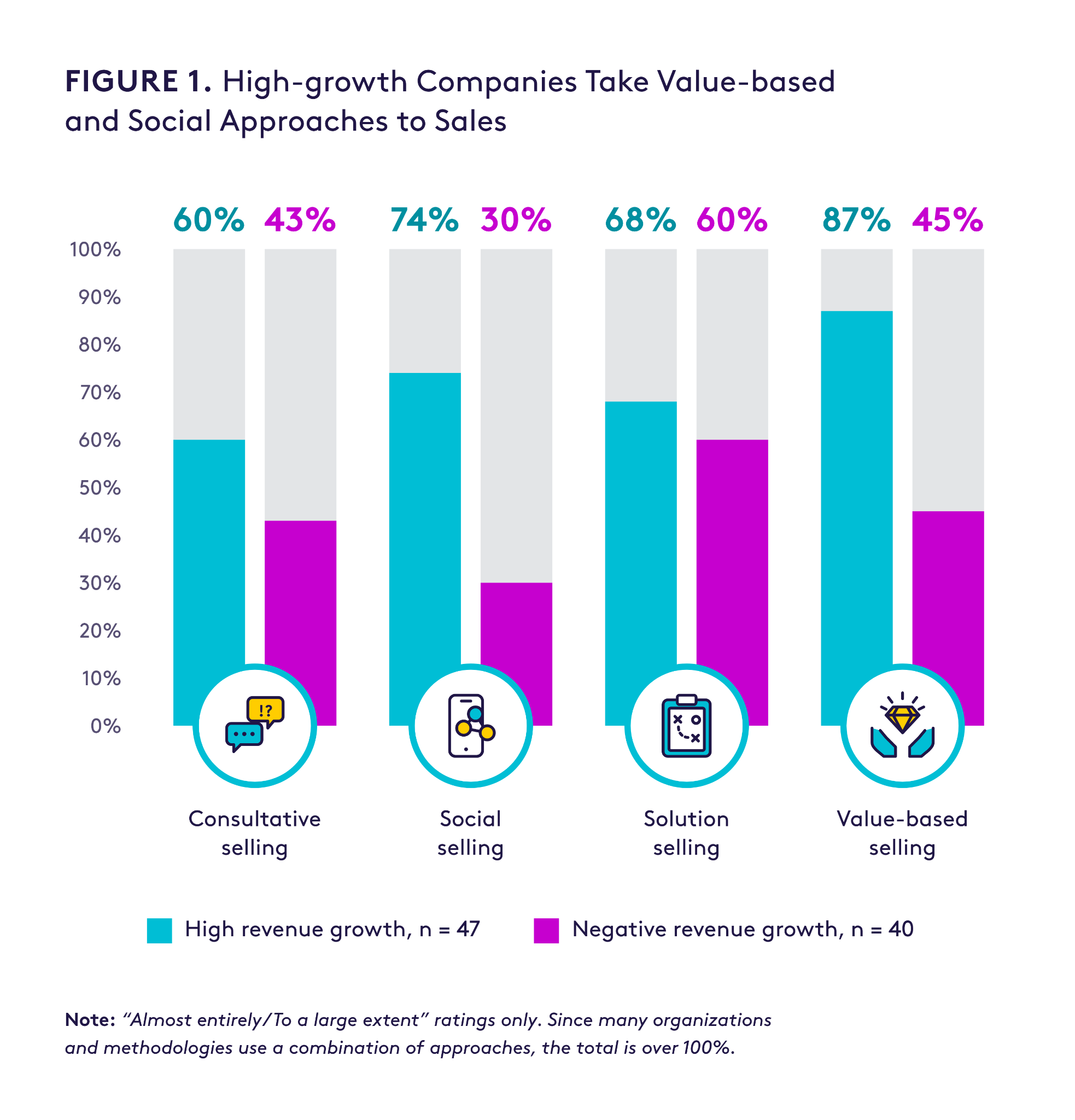
This article breaks down why this approach works, how value framing rebuilds the trust modern buyers demand and what the client data proves when teams make the switch.
What Is Value-Based Selling? (And Why It Wins)
Value-based selling is a sales methodology built around the buyer's business outcomes rather than product features or price. Sellers lead with a product’s measurable impact for the buyer, which could be:
- improved revenue
- avoided costs
- reduced risk
- saved time
When reps lead with features or price, they lose deals to better demos or more affordable products. When reps sell on the business outcome, the buyer understands what’s at stake if they pass up the opportunity.
We define value-based selling this way:
"Communicating value is the art of quantifying the high-level value proposition for each prospective customer, drilling down from the generic promise and tying it to the buyer's unique challenges and priorities. Most importantly, you must co-create this with the buyer, so they have confidence in the final number."
Going from selling around a generic promise to the buyer's own numbers makes a pitch into a business case. The Value-Based Sales Guide covers the full methodology, and our research on the seven habits of top performers puts communicating value at the top of the list.
The Buyer Confidence Gap: Why Value Framing Closes Deals
Sellers must earn the trust of B2B buyers, and that looks different today with AI than it did just a few years ago. The buyer confidence gap occurs when decision cycles extend, buyers have doubts and sellers cannot adequately address their concerns. Value-based selling is not a style approach. It’s a strategic response to how B2B buying has changed and the future of win rates in sales.
Almost 70% of B2B buyers now turn to sales reps to validate the AI-generated insights they gather on their own. Buyers arrive at the conversation having already researched the vendor, the competitors and the pricing with AI tools. That makes the seller essential for either confirming the buyer's research or debunking it.
The skills separating top performers are value skills, not product skills. Research found that top-performing sellers are 60% more likely to present overall value effectively and 63% more likely to build and communicate strong ROI and financial cases for buyers.
Decision cycles keep stretching, buying committees keep growing and buyers keep doing more of the early work themselves with AI. A rep who quantifies outcomes for the buyer closes the gap: the buyer stops weighing options on price and starts building the internal case to buy.
The Data: How Value-Based Selling Moves Win Rates
Value-based selling sounds great in theory, but what is the true return on investment? This section makes the case in three layers: what independent research shows, what our own research found and what happened at client companies after adoption.
What Independent Research Shows
Buyers abandon deals when sellers do not speak to their motivators. Gartner research found that 77% of B2B buyers describe making a purchase as very complicated or difficult, and buyers use words like "time consuming" and "painful" to describe the experience.
Reps who make the buyer’s decision easier improve win rates, and the best way to do this is through value framing: it replaces a feature comparison the buyer has to consider with a quantified outcome the buyer can share with a buying committee.
AI has raised the bar on the seller's side, too. As AI takes detail-specific work off sellers' plates (research summaries, forecasting, personalized recommendations), sellers must bring more judgment and expertise to buyer conversations.
Read More: Discover Our Resources for the Role of AI in Sales
ValueSelling's Own Research: What Top Performers Do Differently
It’s no secret the current market is challenging to win. ValueSelling's proprietary research shows what makes a difference. According to ValueSelling's research of more than 150 sales leaders, there are seven winning habits of top sales performers.
The first one, communicating value, is the habit the other six depend on.
Sellers who lead with quantified value win more consistently because every downstream behavior (discovery, qualification, negotiation) gets easier when the buyer already understands what the outcome is worth. The client results show this:
- Readymode combined AI SDRs with value-based selling and increased revenue by 40%.
- Trend Media rebuilt its sales approach around quantified value for a disrupted market and transformed its results.
- The Weir Group PLC trained its team to sell on value consistently and saw 25% faster sales cycles, a 21% increase in revenue and a 25% improvement in adjusted operating profit.
- Newforma aligned its sales teams around one methodology and anchored conversations in buyer business outcomes, and they saw faster ramp times, improved forecast accuracy and better seller confidence.
Four different companies, four different starting points, but they all stopped selling the product and started selling the quantified outcome. Read more of our case studies here.
Read More: Download Our Value-Based Selling Approach Created with Selling Power
How to Improve Win Rates With Value-Based Selling: A Practical Framework
Value-based selling improves win rates because it changes two components: what the seller asks (business issues instead of product-fit questions) and what the seller pitches (quantified outcomes instead of features).
Put both changes into practice with five steps:
- Identify the business issue. Ask about the executive-level problem the purchase has to solve, not the features the buyer asked for.
- Quantify impact in the buyer's metrics. Express the outcome in revenue, cost, risk or time, using the numbers the buyer's leadership already tracks.
- Identify the buying committee. Identify every stakeholder in the approval process, and learn what each one personally needs the decision to do.
- Frame value around stakeholders. Tailor the value story to each decision maker.
- Reinforce in the CRM and coaching. Capture the value story in your CRM so managers can coach to it, and keep the vocabulary alive across the revenue cycle.
Steps one through four occur within deals, and the fifth requires aligning the entire revenue cycle. The ValueSelling Framework addresses all five steps, and our Value-Based Sales Guide covers each in depth.
Read More: Download the Free Value-Based Sales Guide
The Bottom Line: What the Data Proves
Buyers are overwhelmed and looking for a credible guide. ValueSelling's proprietary research shows the selling habits that build buyer confidence are built through communicating value at every stage of the sales process. Our client results show what happens when organizations adopt it: faster cycles, higher revenue, more wins.
Value-based selling improves win rates because it changes what the rep does at every stage of the deal. From prospecting to building trust to closing, each stage gets sharper when the conversation is about the buyer's outcomes instead of the product.
Ready to change your selling approach? Schedule a consultation with our ValueSelling team.
Frequently Asked Questions
How does value-based selling improve win rates?
It improves win rates by shifting the deal from price to quantified business outcomes. Buyers stop comparing vendors on discounts and start comparing them on measurable value, which builds buyer confidence.
How is value-based selling different from other sales methodologies?
Selling on a product or price does not impact the revenue cycle. Value-based selling quantifies business outcomes in the buyer's metrics, so the decision can be defended internally without a discount.
Is value-based selling still effective with AI in the sales process?
Absolutely. AI has made information free, and 69% of B2B buyers now use reps to validate their AI-generated research. That validation role requires judgment and quantified value, which is exactly what value-based selling trains.
How long does it take to see results from value-based selling?
The first changes show up in conversations. Reps start asking about business issues and framing outcomes in the buyer's metrics. Results follow as coached deals advance, and ValueSelling's reinforcement model (30-, 60- and 90-day check-ins) keeps the behaviors in place until the numbers move.
How do I get started with value-based selling?
Start with one live deal: identify the business issue, quantify the outcome and present it to the buying committee. To roll the discipline out across a team, the Value-Based Sales Guide is a great deep-dive resource, or contact our team today.
Share this post


About the Author

Explore More