The Complete Guide to AI in Sales: Tools, Strategies & Best Practices for Revenue Teams

Remember when AI was a future-state concept? Now it’s changing the way major industries operate every single day—and for your sales team, this once-abstract tool can provide a significant and real advantage.
From AI-powered sales coaching to deal intelligence, prospecting, and account planning, AI in sales is reshaping how revenue teams operate, improve performance, and drive growth. But while adoption is accelerating, many organizations struggle to move beyond experimentation. Sales leaders are flooded with AI sales tools, point solutions, and promises of instant productivity. Yet, results often fall short when AI is implemented without strategy, structure or a proven sales methodology.
This guide helps you close that gap.
Drawing on 30+ years of sales training expertise, powered by the ValueSelling Framework® methodology, and real-world AI sales implementation insights, this comprehensive guide explores how artificial intelligence in sales actually works, where it can deliver the most impact and how to implement AI sales technology in a way that drives measurable business results, without sacrificing the human connection that B2B selling demands.
83% of teams using AI reported revenue growth in 2024 compared to those without AI
What You'll Learn in This Guide
- The current state of AI adoption in sales: What it really means, how it differs from automation and the performance gaps between AI users and non-users
- How AI is transforming core sales functions: From coaching and prospecting to deal management and account planning
- Where AI delivers the most value and where humans still lead: Plus, how to choose the right tools for complex B2B environments
- A practical framework for implementing AI: Step-by-step guidance and how to measure ROI to prove impact to stakeholders
- What's next for AI-powered sales: How to future-proof your team for the evolving landscape
What Is AI in Sales? Definition and Overview
Defining AI Sales Technology
AI in sales is the use of artificial intelligence technology (such as machine learning, natural language processing and predictive analytics) to support how sellers qualify, engage and pursue opportunities. It turns sales data into practical guidance that improves effectiveness and results across revenue teams while maintaining authentic human connections.
Unlike traditional sales automation, which focuses on task execution and workflow efficiency, AI sales technology analyzes patterns, learns from data and adapts over time.
AI-powered sales solutions help teams answer questions such as:
- Which opportunities are most likely to close?
- Where are reps struggling to advance deals?
- Which skills need coaching right now?
- Which accounts hold the greatest expansion potential?
AI is a powerful tool, but it’s important to acknowledge just that: it’s a tool, not a cure-all, and must be leveraged appropriately for best results.
The Evolution from Automation to Intelligence
Just as written text evolved from stone tablets to word processors, sales support technology has constantly grown to become a key part of the modern business landscape. Early Customer Relationship Management (CRM) systems centralized customer data, automation tools improved activity tracking and workflow execution, and revenue intelligence platforms added enhanced visibility.
AI represents the next evolution: machine intelligence layered on top of reliable human processes.
Instead of requiring sellers and managers to interpret dashboards manually, AI surfaces insights, predicts outcomes and recommends actions in real time. It takes sales data from simple reporting to structured guidance, enabling it to target the exact assistance your team needs.
Read More: How AI Is Shaping the Future of Sales
The Current State of AI in Sales
AI Adoption Statistics Every Sales Leader Should Know
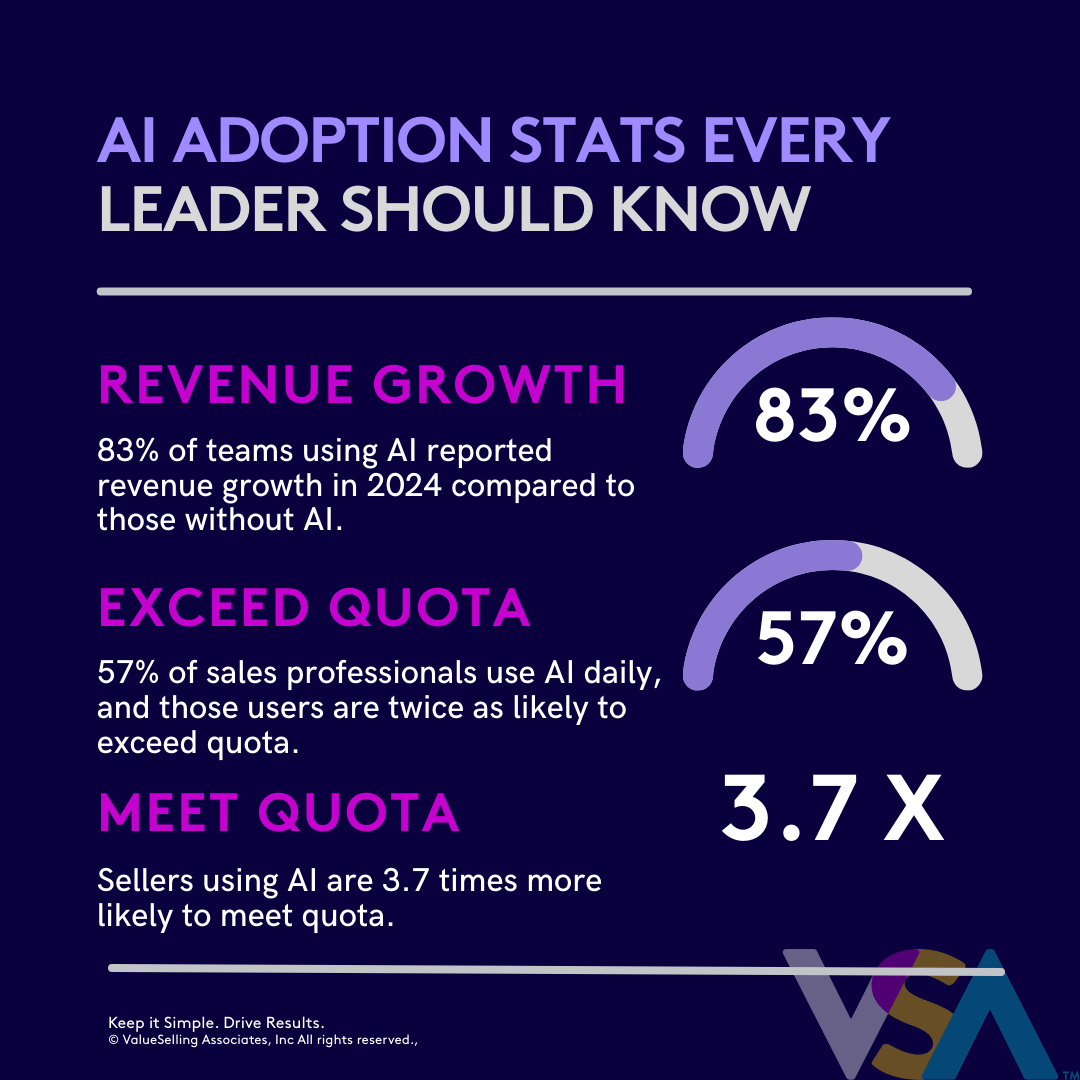
AI adoption in sales has nearly doubled in the last two years. Performance data shows why:
- 83% of teams using AI reported revenue growth in 2024 compared to those without AI
- 81% of AI-enabled sales teams report increased revenue
- 56% of sales professionals use AI daily, and those users are twice as likely to exceed quota
- Sellers using AI are 3.7 times more likely to meet quota
The Performance Gap: AI Users vs. Non-Users
The most compelling case for AI adoption is the widening performance gap. Sales teams that leverage AI outperform non-AI teams by 17% (Salesforce) across win rates, quota attainment and revenue growth.
This gap continues to grow as AI tools mature and organizations learn how to embed them into daily selling behaviors, especially when AI is aligned with a clear sales methodology.
Read More: Explore 2025’s Top Sales Training Trends
How AI Is Transforming Key Sales Functions
AI for Sales Coaching and Skill Development
Sales coaching remains the single biggest performance gap in most organizations. Traditional coaching models struggle because managers are stretched thin, coaching is inconsistent and feedback is reactive instead of proactive.
AI sales coaching changes the equation.
True AI coaching simulates the impact of an experienced human coach to deliver consistent, personalized guidance at scale. ValueSelling’s AI coach, ValueCoach AI, helps you analyze seller behavior, identify skill gaps, reinforce what’s working and create structured improvement plans tailored to individual needs.
.png)
Read More: Download the ValueCoach AI Flyer and AI Sales Coaching vs. Human Sales Coaching
AI for Sales Prospecting and Lead Generation
AI dramatically improves sales prospecting by helping teams identify the right buyers earlier and engage them more effectively. By analyzing firmographic data, behavioral signals and historical performance, AI-powered tools can refine ideal customer profiles (ICPs), score leads based on buying intent and prioritize outreach where sellers are most likely to see results.
Automated outreach capabilities further support this process by enabling personalized, timely engagement. Organizations that adopt AI for prospecting report up to a 50% increase in lead generation, driven by higher-quality conversations and more efficient use of selling time.
Read More: Get More Done with Vortex® Prospecting
AI for Deal Management and Pipeline Intelligence
In complex B2B sales cycles, AI brings clarity and objectivity to deal management and pipeline visibility.
AI-powered systems continuously evaluate opportunity data, buyer engagement and seller behaviors to predict deal risk, score opportunities and flag issues before they derail outcomes. This enables sales leaders to move beyond reactive pipeline reviews and toward proactive coaching and decision-making.
With AI support, many organizations see up to a 40% improvement in forecast accuracy — allowing for more confident revenue planning and resource allocation.
As an add-on feature of the ValueSelling Assistant, tools like eValuePrompter support this effort with AI-embedded workflows that help sellers qualify opportunities, prepare for sales conversations, advance deals and reduce administrative work every day.
AI for Strategic Account Planning
The days of manually inputting customer data into actionable account intelligence are gone. AI enhances strategic account planning by doing this for you. By analyzing engagement patterns, historical performance and whitespace opportunities, AI helps sellers identify expansion potential, map stakeholder relationships and anticipate shifts in customer priorities.
This insight helps teams align around shared goals, deliver more relevant value-based conversations, and execute account strategies with greater precision. Organizations using AI-supported account planning report up to 5% higher account growth, driven by better coordination and deeper customer understanding.
Solutions like the ValueSelling Account Plan (VSAP) bring this intelligence together in a structured, repeatable framework that supports long-term growth and stronger executive relationships.
The Human + AI Balance: Why Both Matter
What AI Does Best in Sales
AI excels at:
- Processing large volumes of data
- Identifying nuanced patterns humans miss
- Automating administrative work
- Providing consistent, always-on support
AI systems and tools speed up selling time by reducing manual, administrative tasks and ensuring insights are never dependent on gut instinct alone.
What Humans Do Best in Sales
Real, authentic human sales professionals will always remain essential for:
- Relationship building
- Emotional intelligence
- Complex negotiation
- Strategic thinking
- Empathy for others
- Trust development
AI can have significant benefits for your business, but the reality is this:
AI informs decisions. Humans make them.
The Hybrid Approach That Wins
As CEO David Connors discusses on our ValueSelling podcast, the highest-performing sales teams know that a healthy blend of technology and humans achieves the best results. The ValueSelling Framework® methodology, developed and perfected over more than three decades, provides the foundation for human-centered selling. Our modern AI tools are built for seamless integration and scale insight, consistency and execution.
Read More: Why the Human Touch Still Matters
AI Sales Tools Comparison: Choosing the Right Solutions
If you’re familiar with Salesforce's AI, ValueSelling goes even further. All of our RevTech tools offer an add-on that enables you to leverage Agentforce's capabilities inside the tools to provide advanced functionality.
.png)
Measuring the ROI of AI in Sales
Leading Indicators to Track
The earliest signs of AI impact show up in day-to-day selling activity that directly influences pipeline health. Unlike pipeline velocity or conversion rates (which reflect what already happened), true leading indicators reveal behavioral changes as they occur. Sales leaders should monitor factors like the following:
- increases in high-value selling activities such as executive-level meetings, discovery calls with multiple stakeholders, or outreach to new personas within target accounts
- improvements in message personalization and relevance, measured through higher email response rates or meeting acceptance rates
- faster rep response times to inbound leads or more consistent follow-up cadence on active opportunities
After implementing AI-powered call coaching, one sales team tracked the percentage of discovery calls where reps successfully identified budget, timeline, and decision-makers, three qualification criteria the AI was trained to reinforce. Within 30 days, calls meeting all three criteria jumped from 34% to 68%, and those opportunities converted at nearly double the rate of partially qualified deals.
Lagging Indicators That Prove Value
While leading indicators show momentum, lagging indicators confirm long-term business impact. Organizations that successfully deploy AI in sales consistently see higher win rates, measurable revenue growth and increases in average deal size as sellers focus on higher-quality opportunities.
Reductions in overall sales cycle time and meaningful improvements in forecast accuracy further demonstrate that AI is not only accelerating deals but also improving predictability and confidence where revenue is concerned.
Real-World Results
The data behind AI-driven sales says more than any fleeting trend could. Independent research shows that organizations using AI effectively achieve 30% or greater improvements in win rates. These results reinforce that AI delivers the greatest value when it is implemented with clear goals, strong adoption and a structured framework for execution.
Companies that don’t take advantage of growing artificial intelligence technology will have a harder and harder time keeping up in the B2B sales landscape. See how organizations are unlocking AI’s potential for revenue growth.
The Future of AI in Sales: Trends and Predictions
Agentic AI and Autonomous Sales Workflows
AI agents represent the next evolution beyond generative AI: the AI agent market is projected to reach $47.1 billion by 2030. Agents execute tasks autonomously across workflows, from researching accounts and preparing call plans to triggering follow-ups and updating CRM records without manual input. As these systems mature, they’ll increasingly shift sales teams from task execution to decision oversight, allowing sellers and managers to focus on strategy, judgment and relationship-building while AI handles admin work at scale.
Hyper-Personalization at Scale
As AI matures, sales organizations are moving beyond mere surface-level personalization and onto true hyper-personalization at scale. Deeper CRM integrations allow AI to unify data across marketing, sales and customer success, creating real-time updates for each account and buying group. This allows for deep, real-time personalization across messaging, pricing, engagement and more.
Preparing Your Team for the AI-Enabled Future
Successfully adopting AI in sales demands new skills, behaviors and ways of thinking. Sales teams must develop the ability to interpret AI insights, ask better questions and apply recommendations within the context of real customer conversations. Continuous learning becomes essential as AI evolves, ensuring sellers and managers can adapt quickly without reverting to outdated habits. Most importantly, AI must be grounded in a consistent sales methodology that guides how insights are used in real, human ways.
The ValueSelling Framework® provides a future-proof foundation, combining decades of proven methodology with modern AI capabilities to ensure technology enhances judgment, reinforces value-based behaviors and drives sustainable performance over time.
Frequently Asked Questions About AI in Sales
Q: Will AI replace salespeople?
A: No. AI augments human capabilities, handling data and administrative tasks while humans focus on relationships and strategic selling. Research shows sellers using AI are 3.7 times more likely to meet quota, showing that AI amplifies human performance instead of replacing it.
Q: What is the ROI of AI sales tools?
A: Organizations report 7 to 15 times their ROI in the first year, with 81% of AI-using sales teams reporting increased revenue. Win rates tend to increase 26-35% when AI guides deals effectively.
Q: How long does AI implementation take?
A: Initial deployment typically takes 3 to 6 months, with 74% of companies gaining ROI within the first year. Cross-functional alignment can reduce implementation time by 25-30%.
Q: What AI sales tools should we start with?
A: Start with high-impact use cases aligned to your biggest challenges: coaching for skill development, deal management for pipeline visibility or prospecting for lead generation.
Q: How does AI sales coaching work?
A: AI coaching analyzes sales conversations and behaviors, identifies skill gaps and delivers personalized feedback and training recommendations in real-time. It’s available 24/7 to supplement human coaching.
Ready to Transform Your Sales Organization with AI?
AI alone doesn’t drive results. AI aligned to a proven sales methodology does.
ValueSelling combines 30+ years of sales expertise with modern AI sales solutions to help revenue teams execute more effectively, coach more consistently and win more often.
Take the next step:
Download: How AI Is Shaping the Future of Sales
Share this post


Explore More