E-commerce Growth Strategy: How Brands Scale Without Sacrificing Profit Margins
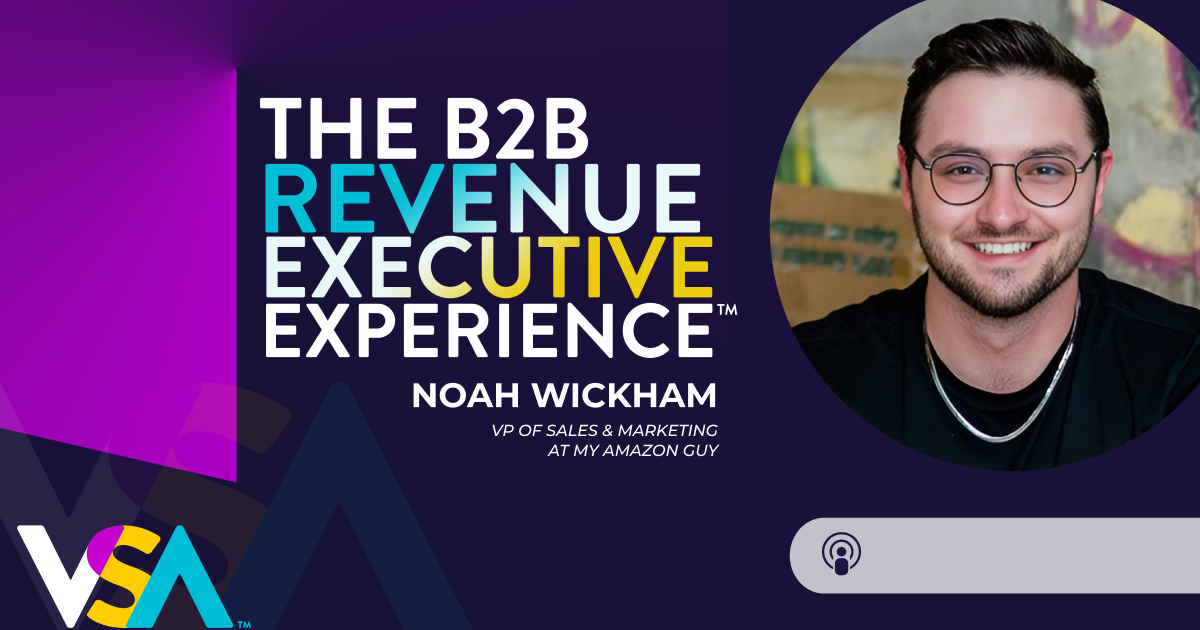
E-commerce growth is often framed as a marketing challenge, but Noah Wickham, VP of Sales and Marketing at My Amazon Guy, a full-service Amazon agency, argues that most brands fail long before customer acquisition becomes the problem.
In his experience of working with more than 1,000 brands across Amazon, direct-to-consumer channels, and multichannel e-commerce environments, he explains why the real differentiator between success and failure comes down to whether the business has built the financial and operational foundation required to scale.
In this episode of The B2B Revenue Executive Experience, Noah joins host Cory Cotten-Potter to discuss the e-commerce growth strategy that works, PPC advertising optimization for e-commerce, cash flow management, and the mindset shifts that separate brands that thrive from those that disappear within their first two years.
From establishing healthy profit margins in e-commerce to diagnosing stalled growth and embracing rapid experimentation, the conversation offers practical lessons for e-commerce founders and B2B revenue leaders alike.
Profitability Is the First Growth Strategy
Many founders believe growth will solve profitability problems, but Noah has seen the opposite happen repeatedly. According to him, brands launching with less than 15% net profit per unit are often setting themselves up for failure. While there are exceptions, his preferred benchmark is closer to 25% net profit.
That recommendation has less to do with maximizing earnings and more to do with creating options.
A brand operating at a 5% margin has very little room to absorb rising fulfillment costs, invest in advertising, or recover from inventory disruptions. Meanwhile, a business with stronger margins can continue reinvesting in growth without jeopardizing cash flow.
This perspective fundamentally changes how leaders should think about their e-commerce business model. Profitability is not simply an accounting metric. It determines whether a company can survive unexpected challenges, test new channels, and continue scaling as conditions change.
For leaders evaluating their direct-to-consumer strategy, understanding unit economics before launch is one of the most important exercises they can undertake.
Why Cash Flow Determines Whether Brands Scale
Noah repeatedly returns to the theme of proper cash flow management for sustained e-commerce growth. He has seen businesses generate millions in revenue while remaining fundamentally weak because they lacked the cash reserves needed to support growth.
Scaling introduces multiple complexities, including increased inventory requirements and higher advertising budgets, and logistics become more challenging. Without adequate cash flow, growth itself can become the source of failure.
This is particularly relevant in today's environment, where investors and operators are increasingly prioritizing sustainable growth over "growth at all costs." The lesson applies beyond e-commerce.
For B2B organizations experiencing stalled growth, revenue leaders should ask whether their current investments are creating long-term resilience or simply masking underlying weaknesses.
Growth remains important, but profitable growth creates flexibility, and flexibility delivers longevity.
Common Sense Advertising Still Wins
While PPC advertising for e-commerce has become increasingly sophisticated, Noah advocates for a simpler approach. He refers to it as "common sense advertising." The premise is straightforward: most brands do not have a strategy problem. They have an execution problem.
Many organizations spend hours analyzing dashboards while overlooking obvious inefficiencies. Search terms that never convert remain active, campaign settings are left untouched, and advertising dollars continue flowing toward audiences with little purchase intent.
Instead of overcomplicating campaign management, Noah recommends asking two questions regularly:
- Are we reaching the right people?
- Are they taking the desired action?
That mindset can dramatically improve advertising ROI.
A key actionable recommendation involves using Google Search Network. Noah argues that many advertisers unknowingly waste significant budget by leaving this setting enabled, extending campaigns beyond high-intent search traffic.
For brands looking to improve PPC performance, small operational adjustments often deliver larger returns than wholesale strategy changes. This reinforces a broader truth about e-commerce scaling: consistency frequently outperforms complexity.
Authentic Content Has Become a Competitive Advantage
Another major theme throughout the conversation was the growing importance of authentic content.
For years, B2B organizations approached marketing through a corporate lens. Content was polished, heavily branded, and focused almost exclusively on products and services.
That approach is becoming less effective.
Consumers and business buyers increasingly respond to people rather than logos. Noah attributes much of My Amazon Guy's success to building a recognizable personality around the brand.
Rather than producing content designed solely to sell, he focuses on answering questions and providing immediate value.
This shift aligns closely with broader changes in brand positioning.
Whether you're building an Amazon selling strategy or growing a consulting business, audiences want expertise presented through a human voice. They want practical advice they can implement immediately.
The result is greater trust, stronger engagement, and ultimately more demand generation. For organizations investing in multichannel e-commerce initiatives, content is no longer just a supporting tactic. It has become a primary growth engine.
Diagnose Growth Problems at the Top of the Funnel
When businesses experience declining revenue, many leaders instinctively focus on sales performance. Noah recommends looking elsewhere first, and in his view and experience, growth problems almost always begin at the top of the funnel.
He encourages leaders to visualize their pipeline as an actual funnel rather than a straight cylinder. If awareness declines, every downstream metric suffers accordingly. A reduction in impressions leads to fewer clicks, leads, and fewer customers.
My Amazon Guy experienced this firsthand when a Google algorithm update negatively affected keyword rankings and organic visibility. The issue was not sales execution. It was a declining awareness.
This framework is particularly valuable for B2B organizations attempting to align sales and marketing efforts. Rather than asking why close rates have fallen, leaders should first ask whether enough qualified prospects are entering the pipeline in the first place.
Understanding this relationship can dramatically improve how organizations approach demand generation and growth planning.
Speed and Iteration Beat Perfection
Noah also shares a lesson he wishes he had learned earlier in his career, one of being more flexible. Like many entrepreneurs, he once believed success required perfect planning, and experience has taught him that good execution beats perfect planning.
Today, he believes speed and iteration are among the most valuable skills a leader can develop. The businesses that test multiple strategies consistently outperform those waiting for perfect information. Every failed experiment produces insight, and every successful experiment creates leverage.
This mindset is particularly important as technology continues to accelerate.
AI, changing consumer behavior, and evolving platforms are reshaping e-commerce at an unprecedented pace. Organizations that can adapt quickly will maintain a significant advantage over competitors who move cautiously.
The future will belong to companies that learn faster than everyone else.
Building Brands for the Next Decade
Looking ahead, Noah believes consumer behavior will continue shifting in meaningful ways. Buyers increasingly care about one of two things: strong brands or exceptional value.
At the same time, emerging technologies like AI-powered shopping assistants may further reduce the importance of traditional brand signals. As purchasing decisions become more automated, value and relevance could become even more important.
That makes today's investments in brand profitability, authentic content, and operational excellence increasingly important.
The companies that succeed over the next decade will not necessarily be those spending the most on advertising. They will be the organizations that combine strong fundamentals with a willingness to adapt.
The conversation serves as a timely reminder that e-commerce growth strategy is ultimately about building resilient businesses. Strong margins create flexibility, a healthy cash flow enables reinvestment, content builds trust, and experimentation drives learning.
When combined, those elements create something every leader is searching for: sustainable growth.
What You’ll Learn
- How to aim for a minimum 25% net profit per unit at launch
- The "Common Sense Advertising" framework
- Why Google Search Network advertising destroys ROI for most brands
- The top funnel diagnostic: when growth stalls, start at awareness
- How to build authentic B2B content that converts
- The speed and iteration advantage
- Why consumer intent is shifting away from brand loyalty to premium brands or pure value plays
Key Insights:
- [00:00] The 25% Profit Margin Rule for e-commerce Brands
Noah explains that healthy profit margins are the foundation of sustainable growth. Brands launching with less than 15% net profit per unit often struggle to survive, while a 25% margin provides the flexibility to invest in marketing, absorb unexpected costs, and scale effectively. For founders and revenue leaders, margins are more than a financial metric. They determine how resilient a business will be over time.
- [11:15] Common Sense PPC Can Improve Advertising ROI
Noah introduces "common sense advertising," a practical framework for improving PPC performance without overcomplicating campaign management. He recommends regularly reviewing search terms, adding negative keywords, and distinguishing between clicks and conversions. Spending just a few minutes each week identifying wasted spend can significantly improve advertising ROI and help brands focus their budgets on audiences most likely to convert.
- [14:07] One Google Ads Setting That Wastes Budget
Noah highlights Google Search Network as a common source of wasted ad spend. Many businesses unknowingly allow ads to appear across Google's partner ecosystem, resulting in lower-intent traffic and weaker performance. His recommendation is simple: disable Google Search Network and focus exclusively on Google Search. This small adjustment can improve cost per acquisition and immediately increase campaign efficiency for many brands.
- [23:39] Start Diagnosing Growth Problems at the Top
When growth slows, Noah advises leaders to begin at the top of the funnel rather than focusing exclusively on sales performance. Declining awareness inevitably impacts every downstream metric. He shares how a Google algorithm update reduced his company's visibility and booked calls. For B2B leaders, monitoring impressions, reach, and traffic is often the fastest way to uncover the true source of stalled growth.
- [25:57] Become a Sponge Before Launching a Business
Noah encourages aspiring entrepreneurs to spend time absorbing as much information as possible before launching a business. With thousands of free resources available online, founders can accelerate their learning and avoid costly mistakes. He also recommends seeking advice from people who have already achieved success in the field, noting that most experienced operators are surprisingly willing to share their knowledge.
- [30:57] Why Speed and Iteration Beat Perfection Every Time
Looking back on his career, Noah says he wishes he had embraced flexibility earlier. He believes businesses gain an advantage by testing ideas quickly rather than pursuing perfect solutions. Every experiment generates valuable insights, even when it fails. Leaders who iterate rapidly will accumulate knowledge faster, adapt more effectively to change, and ultimately outperform competitors who spend too much time planning.
FAQs
1. What is the ideal profit margin for an e-commerce business?
According to Noah, brands should aim for at least a 25% net profit margin whenever possible. Strong profit margins in e-commerce provide the cash flow needed to reinvest in marketing, manage inventory, and support e-commerce scaling. Businesses operating below 15% margins often struggle to sustain growth over the long term.
2. How can businesses improve PPC advertising performance?
Brands can improve PPC advertising for e-commerce by regularly reviewing search terms, adding negative keywords, and focusing on conversion data rather than clicks alone. Noah recommends using a "common sense advertising" approach to identify wasted ad spend quickly and improve advertising ROI without spending hours analyzing campaign reports.
3. Why do e-commerce brands struggle to scale successfully?
Many e-commerce brands fail because of poor cash flow management, weak unit economics, and insufficient reinvestment. Noah explains that the e-commerce growth strategy starts with profitability. Without healthy margins and a sustainable e-commerce business model, companies often lack the resources needed to manage inventory, marketing, and operational growth effectively.
4. What should leaders do when business growth starts to slow?
Noah advises leaders to start at the top of the funnel. Declining awareness often leads to fewer leads and lower revenue. Reviewing traffic sources, search visibility, and multichannel e-commerce performance can help identify the root cause. In many cases, improving demand generation is more effective than changing sales processes.
Share this post


Explore More