How Revenue Marketing Makes the CMO a Business Growth Driver
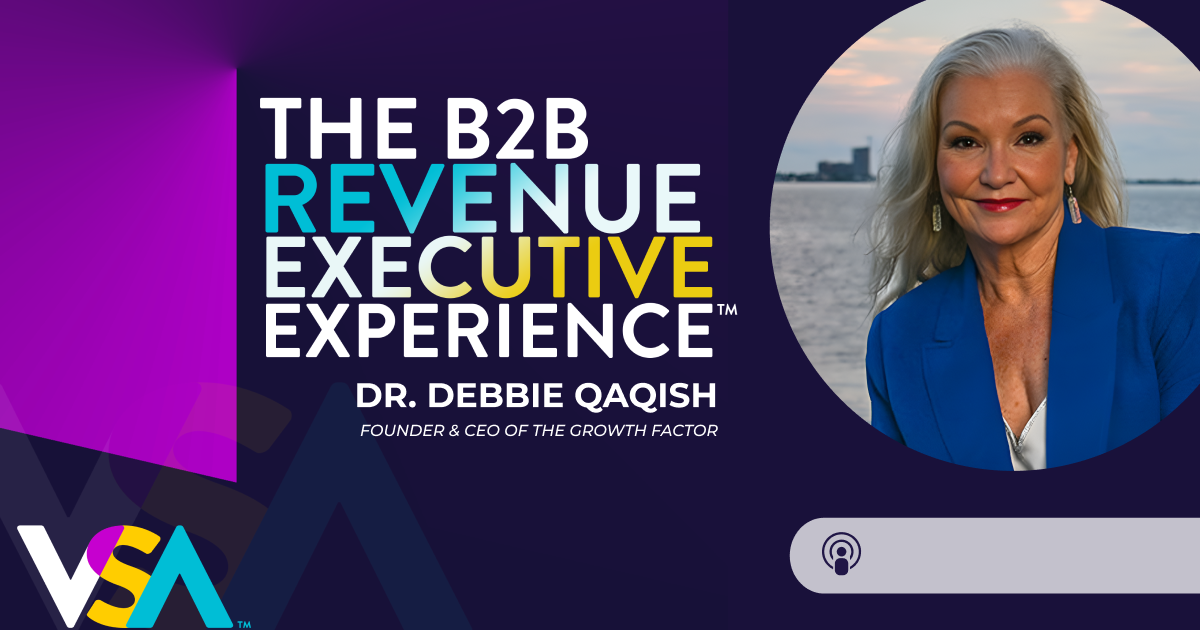
Marketing has spent decades trying to prove its value to the rest of the business. Dr. Debbie Qaqish (Gah-geesh), is a leading expert in B2B revenue marketing, Founder and CEO of The Growth Factor, Partner at The Pedowitz Group, and best-selling author who argues that the time has come to stop treating marketing as a cost center and start treating it as a core part of the revenue team.
In her view, revenue marketing means transforming marketing from a cost center into a revenue center. That shift requires more than new technology or better reporting. It requires a fundamental change in how organizations define the CMO's role, measure marketing performance, and align sales and marketing around revenue.
In this episode of The B2B Revenue Executive Experience, Debbie joins host Cory Cotten-Potter to discuss revenue marketing, CMO leadership, AI in sales and marketing, sales coaching, psychological safety, and the changing responsibilities of revenue leaders.
From recognizing the warning signs of burnout to redefining leadership as an "architect of change," the conversation offers practical guidance for leaders navigating constant technological change without losing the human capabilities that make revenue teams effective.
Turn Marketing From a Cost Center Into a Revenue Center
Debbie's definition of revenue marketing is straightforward: marketing must become a revenue-generating function rather than a department focused primarily on building brand awareness.
She first recognized the potential of this model in the early 2000s, when marketing technology made it possible to connect marketing activity directly to sales outcomes. Implementing platforms such as Salesforce and Eloqua demonstrated how technology could help sales and marketing operate as a unified revenue team.
However, Debbie feels that this transformation still remains a work in progress at many organizations.
For Debbie, CEOs and CFOs have a responsibility to maximize the resources available to the business. Marketing should therefore be part of the revenue team, with clear accountability for pipeline contribution, revenue, and business outcomes.
This shift would also change the CMO’s role. Effective CMO leadership increasingly requires an understanding of revenue team strategy, sales performance, customer behavior, and the technology that connects these business verticals.
Marketing operations play an important role in making that connection measurable. When marketing teams have revenue targets and can demonstrate their contribution to pipeline and closed business, the conversation with the rest of the executive team becomes fundamentally different.
The Age of Overwhelm Is Changing Leadership
The demands placed on revenue leaders have also changed dramatically.
Debbie describes today's working environment as an "age of overwhelm." Constant connectivity, remote work, rapid technological change, and an endless stream of information create an environment where leaders rarely have meaningful time to stop and think.
And the consequences extend beyond personal stress: decision-making under stress becomes more reactive, and leaders can lose access to the strategic thinking required to guide their teams effectively.
Debbie connects this challenge to neuroscience and positive psychology in business. When people experience sustained pressure, their ability to think creatively, remain curious, and evaluate situations objectively can deteriorate.
That has direct implications for leadership under pressure.
Leaders who become increasingly reactive may begin making decisions too quickly, taking work back from their teams, or focusing almost entirely on tactical execution. Over time, those behaviors can weaken delegation, reduce sales coaching, and prevent teams from experimenting with new approaches.
Developing resilience is therefore not simply a personal wellness exercise. It can directly affect revenue team performance.
Three Signs Your Revenue Leader Is Burning Out
Debbie identifies three behavioral patterns organizations should watch for when evaluating decision-making under stress.
The first is increasingly reactive decision-making. Leaders under pressure may prioritize speed over quality and make decisions without giving themselves enough time to consider the broader consequences of their decisions.
The second is taking work away from the team. A leader who begins pulling execution tasks back to themselves or concentrating responsibilities with one trusted individual may be struggling to manage the pressure of the role.
The third is a shift from strategy to tactics. When every leadership conversation becomes about immediate execution, there is little space left for strategic planning, experimentation, or coaching.
These behaviors can be particularly difficult to identify because high-performing leaders often become skilled at hiding stress.
Organizations can respond by paying attention not only to results but also to how decisions are being made, how responsibilities are distributed, and whether leaders still have the capacity to think beyond the current quarter.
AI Is Redefining the Role of the Revenue Leader
AI in sales and marketing is creating another layer of change.
Debbie believes AI should not be viewed simply as another technology added to the existing Martech stack. It is changing the nature of work itself.
As AI takes over more execution tasks, revenue leaders will need to spend less time managing individual activities and more time designing systems, developing people, and adapting organizations to changing customer behavior.
This is where the concept of an "architect of change" becomes important.
Instead of asking how teams can execute more efficiently within an existing model, leaders need to examine how AI changes the customer journey, the responsibilities of employees, the structure of teams, and the skills required to succeed.
That requires change management at a much deeper level.
Debbie recommends taking a step back and considering the future without being constrained by legacy processes. Sales and marketing leaders should examine what selling will look like, how customers will behave, and what their own roles should become in an AI-driven environment.
Psychological Safety Supports Adaptability
Technology alone will not make organizations more adaptable.
Debbie argues that psychological safety has become one of the most important leadership capabilities for organizations experiencing significant change. Employees need to feel comfortable questioning decisions, raising concerns, and challenging assumptions without fear of being punished.
This is especially important as AI creates uncertainty around jobs and responsibilities.
Sales and marketing alignment becomes harder when employees are operating from fear. People become less willing to experiment, ask questions, or share information that could expose a mistake.
Creating psychological safety gives teams the confidence to remain curious during periods of disruption.
That curiosity matters because the relationship between technology and human performance is not purely technical. Organizations still need people who can understand customers, interpret context, build relationships, and make thoughtful decisions.
Sales Coaching Must Evolve With the Team
The conversation also explores how sales coaching can change in an AI-enabled environment.
AI can provide immediate feedback after a sales call, helping sellers identify problems and improve specific skills without waiting for a manager's next coaching session. That makes AI a useful complement to human coaching rather than necessarily a replacement for it.
For example, a seller could upload a call, receive feedback on their performance, and identify areas for improvement immediately. If the same issue continues to appear across multiple calls, a manager can then step in with deeper, human-led coaching.
This creates a hybrid model in which technology handles immediate feedback while managers focus on patterns, context, development, and empathy.
The same approach can extend beyond traditional sales skills. Positive psychology in business can be incorporated into coaching by helping sellers reframe setbacks, maintain a growth mindset, and recover from difficult interactions.
Leaders Need to Get Off the Hamster Wheel
Perhaps the most personal lesson from the conversation is Debbie's advice to step away from constant execution.
She reflects on spending years on the "hamster wheel," always performing and completing tasks without enough time for reflection. Her advice to today's leaders is to build periodic recovery and reflection into their working lives.
A short walk, a vacation, or a structured period of focused work can create the mental space required for better decisions and clearer thinking.
For revenue leaders, this matters because strategic thinking requires space. A leader who is constantly reacting to messages, meetings, targets, and operational problems has less capacity to think about the future.
The broader lesson is that sustainable performance requires more than productivity. Leaders need the time and mental capacity to understand change, support their teams, and make better decisions.
As AI continues reshaping sales and marketing, the organizations that succeed will not simply be those with the most advanced technology. They will be the ones that combine revenue marketing, effective marketing operations, strong sales coaching, and adaptable leadership with an understanding of how people actually perform under pressure.
For today's CMO and revenue leader, that means moving beyond execution and becoming a strategic driver of growth, adaptability, and organizational performance.
What You’ll Learn
- How to transform marketing from a cost center to a revenue center
- The three warning signs of burnout in revenue leaders
- Why your brain isn't evolved for the "infinite workday"
- How AI fundamentally changes leadership roles from execution task masters to architects of change and adaptability
- Five depressurization techniques you can use at your desk in under ten minutes
- Why curiosity is the strongest predictor of success in modern sales and marketing
Key Insights:
- [06:59] Turn Marketing From a Cost Center Into a Revenue Engine
Debbie defines revenue marketing as the transformation of marketing from a cost center into a revenue center. She argues that marketing must be treated as part of the revenue team, with clear accountability for pipeline and business results. Technology such as Salesforce and Eloqua helped make this possible by connecting sales and marketing. For executives, the shift requires recognizing marketing's direct contribution to growth and shareholder value.
- [09:02] Why Revenue Leaders Are Struggling in the Age of Overwhelm
Debbie describes today's workplace as an "age of overwhelm," where constant connectivity, rapid technological change, and endless demands create sustained pressure. When leaders operate in this state, they can become reactive, make poorer decisions, and lose access to strategic thinking. She believes organizations need to combine positive psychology and neuroscience with leadership development, giving revenue teams practical tools to build resilience, manage pressure, and perform effectively in an always-on environment.
- [24:04] Three Warning Signs Your Revenue Leader Is Burning Out
Debbie identifies three warning signs of burnout among revenue leaders: reactive decision-making, taking responsibilities back from team members, and becoming overly focused on tactics instead of strategy. These behaviors can emerge when leaders are overwhelmed but remain difficult to spot because high performers often hide their stress. Organizations should monitor decision quality, delegation, and strategic thinking while providing leaders with the support and tools needed to prevent burnout from affecting their teams.
- [31:24] Become an Architect of Change in the Age of AI
Debbie argues that AI is fundamentally changing the role of revenue leaders. Instead of acting as execution-focused task managers, leaders need to become architects of change and adaptability. That means reassessing how AI affects selling, customer journeys, team structures, and leadership responsibilities. She also emphasizes teaching teams skills such as reframing setbacks, maintaining a growth mindset, and managing pressure. Leaders must create environments where people can adapt while remaining curious and effective.
- [33:10] Build Psychological Safety to Help Teams Adapt to AI
Debbie sees psychological safety as essential for organizations navigating AI-driven change. Employees need to feel comfortable questioning decisions, raising concerns, and challenging ideas without fear of retaliation. When people feel secure, they are more likely to experiment, stay engaged, and adapt to uncertainty. Leaders can support this by inviting questions, acknowledging that they do not have every answer, and creating an environment where trust, respect, and open communication become part of everyday leadership.
- [41:09] Step Off the Hamster Wheel to Think More Clearly
Debbie reflects on spending much of her career in constant execution mode and wishes she had created more space for reflection and recovery. She argues that periodic breaks can improve creativity, decision-making, and strategic thinking rather than reducing productivity. Whether through a walk, vacation, or structured focus session, leaders need time away from constant demands. Creating that space can help revenue leaders perform better while also modeling healthier working habits for their teams.
FAQs
- What is revenue marketing?
Revenue marketing transforms marketing from a cost center into a revenue center by connecting marketing activities directly to business outcomes. Debbie explains how revenue marketers can contribute to pipeline, sales, and growth while working as part of an integrated revenue team. This approach requires clear accountability, effective marketing operations, and alignment between sales and marketing.
- How is AI changing sales and marketing leadership?
AI is changing sales and marketing leadership by reducing the need for manual execution and shifting leaders toward strategy, adaptability, and team development. Debbie explains why revenue leaders must rethink their roles,
- How can revenue leaders prevent burnout?
Revenue leaders can reduce burnout by recognizing warning signs such as reactive decision-making, excessive tactical focus, and taking work back from their teams. Debbie recommends building resilience, creating time for reflection, and using positive psychology techniques to manage pressure. These practices can improve decision-making under stress while helping sales and marketing leaders maintain strategic focus and team performance.
- Why is psychological safety important for revenue teams?
Psychological safety helps sales and marketing teams navigate constant change without fear of questioning decisions or raising concerns. Debbie explains that leaders who create psychologically safe environments encourage curiosity, experimentation, and adaptability. This becomes especially important as AI transforms revenue team strategy and creates uncertainty around jobs, responsibilities, and organizational structures. Stronger trust can also support collaboration and employee retention.
Share this post


Explore More