Why a Partner-Led GTM Strategy Outperforms Direct Sales
The Strategic Power of Partner-Led GTM: Scaling B2B Revenue Beyond Direct Sales
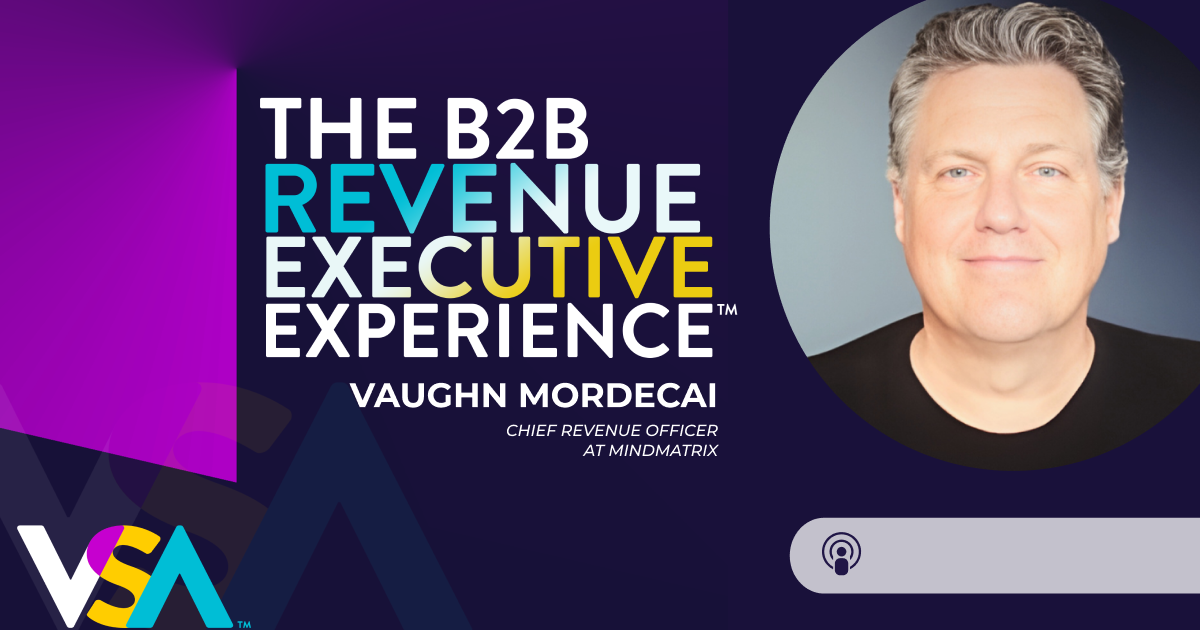
In this episode of The B2B Revenue Executive Experience, host Cory Cotten-Potter sits down with Vaughn Mordecai, Chief Revenue Officer at MindMatrix, to deconstruct the myths surrounding channel sales and explore why a partner-led GTM strategy is becoming the essential lever for B2B organizations looking to scale in a digital-first economy.
Vaughn explains that while many mid-market companies still treat partnerships as a tactical afterthought, the world’s largest technology and manufacturing giants like SAP and HP go to market almost entirely through partner ecosystems. The shift is driven by performance: partner-involved deals consistently yield higher win rates, larger contract values, and faster closing cycles. By leveraging local partners who possess deep customer intimacy and combining that with the resource backing of a global enterprise vendor, the overall customer experience improves significantly.
The Strategic Shift to Partner-Led Go-to-Market
The transition from a purely direct sales model to a partner-led ecosystem is a fundamental shift in how a business views its growth architecture. Vaughn highlights that a partner-led GTM strategy is not just about adding resellers, it is about building a "three-legged stool" of revenue consisting of direct sales, marketing-led inbound, and partner-led ecosystems. Without that third leg, an organization is inherently unstable. In today’s market, where 80-90% of a buyer's journey is completed before they ever speak to a salesperson, partners provide the necessary human-experience-delivered-digitally that modern buyers crave.
Why Year One is the Danger Zone for Partner Programs
One of the most common pitfalls in B2B growth is the premature abandonment of channel initiatives. Vaughn notes that many organizations attempt to launch partner programs when they hit the $5–10 million ARR mark, often as a reactive move to enter new regions like EMEA or Asia. However, because revenue rarely materializes in the first six months, impatient leadership often shuts these programs down.
Vaughn is adamant: fully optimizing a partner motion is a two-to-three-year commitment. Success requires executive-level patience and a long-term strategic horizon.
Solving the Sales Compensation and Friction Problem
Internal alignment is perhaps the greatest hurdle to a successful partner-led GTM strategy. If a direct sales team views a partner as a threat to their commission, they will actively undermine the relationship. Vaughn argues that the only way to eliminate this friction is through a radical rethink of compensation.
By compensating direct sales reps on partner-sourced deals, the organization turns internal competition into collaboration. Furthermore, attribution remains a high-stakes challenge for the CRO and CFO. With modern buying committees growing to 15 or more stakeholders, organizations must implement systems that provide clear visibility into every touchpoint, ensuring that partner contribution is accurately measured and rewarded.
Leveraging AI to Scale Global Partner Ecosystems
As ecosystems grow, fragmentation often follows. Managing multiple communication platforms and disconnected workflows can stifle the very growth the program was designed to create. Vaughn suggests that the future of partnerships lies in AI-powered operating systems rather than standalone tools.
Looking ahead, he predicts that AI-driven workflows and agent-based enablement will further reduce global friction. AI can allow partners to operate in their native languages and local environments while maintaining brand consistency and compliance. By embedding these AI-driven capabilities directly into the daily workflows of partners, vendors can accelerate revenue at a scale that direct sellers simply cannot achieve alone.
Key Quotes:
- "The younger you get, the less you want a salesperson around. Everything is getting further and further towards that digital experience, and so you're left with only 10 or 20% of this actually dealing with humans. So what you have to do is you've gotta create a human experience digitally."
- "The younger you get, the less you want a salesperson around. Everything is getting further and further towards that digital experience, and so you're left with only 10 or 20% of this actually dealing with humans. So what you have to do is you've gotta create a human experience digitally."
- "Partnerships are sort of like the third leg of a three-legged stool. You end up with your marketing, you end up with your sales. And without partnerships, you're kind of finding that you're just not hitting the full value in your organization that you should be hitting."
- "The best way to go about it is to make sure that your salespeople are compensated when the partners bring things over the line. Right? So that it takes away the friction between your salespeople and the partners."
Key Insights:
- [06:54] Transform Partner Programs Into a Strategic Revenue Engine
Partner-led GTM can generate 40–60% incremental revenue through larger deal sizes, faster sales cycles, and improved win rates. Enterprise leaders treat partnerships as a core growth pillar alongside sales and marketing. However, success requires a 2–3 year commitment, experienced leadership, and structured enablement. When executed strategically, partnerships evolve from a scaling support function into a durable competitive advantage. - [10:14] Never Assign Partnership Leadership to Junior or Inexperienced Staff
Partnership programs frequently fail because organisations delegate them to junior hires without strategic authority or experience. Partners managing multiple vendor relationships prioritise companies that are easy to work with and financially rewarding. Without strong leadership, compelling value propositions, and systematic execution, initiatives stall within the first year and are abandoned prematurely. Partnership ownership must sit with credible, senior operators. - [16:02] Align Sales Compensation With Partner-Sourced Deals
Internal sales resistance can undermine partner-led growth before it scales. Direct reps often perceive partner-sourced deals as competition rather than an incremental opportunity. Structuring compensation so sales teams earn commission on partner-driven revenue realigns incentives across the organisation. When reps recognise these deals expand total addressable revenue instead of cannibalising the pipeline, friction decreases, and partnerships gain internal advocacy. - [25:15] Centralize Partner Ecosystem Communication to Eliminate Fragmentation
Complex, multi-vendor deals often suffer from fragmented communication across Slack, Teams, and email, slowing momentum and creating context loss. A centralised ecosystem workspace allows vendors, partners, and co-solution providers to collaborate within one shared environment. By reducing platform switching and aligning assets, organisations improve efficiency, accelerate deal progression, and deliver a more cohesive buyer experience. - [31:43] Create “Human Experiences Delivered Digitally” for Self-Service Research
With most buyers conducting 80–90% of research independently and resisting early sales engagement, companies must design frictionless digital experiences. This includes AI-optimised content, co-branded collateral, certification frameworks, and self-service enablement tools. The goal is to guide buyers through complex ecosystem solutions without heavy salesperson involvement, creating confidence through accessible, well-structured digital resources.
FAQ’s
1. What is a partner-led GTM strategy, and how does it drive revenue growth?
A partner-led GTM strategy drives indirect revenue growth through resellers, integrators, and strategic alliances within a broader partner ecosystem. Unlike direct-only sales models, partner-led motions expand market reach, increase deal size, accelerate sales cycles, and unlock 40–60% incremental revenue that direct teams alone cannot access.
2. Why do most partner programs fail within the first year?
Most partner programs fail due to poor leadership, unrealistic timelines, and a lack of executive commitment. Without senior ownership, structured enablement, and clear partner program ROI measurement, organisations abandon initiatives before the 2–3 year optimisation cycle required for sustainable partner-led GTM success.
3. How do you align sales compensation with partner-sourced deals?
Effective sales compensation alignment ensures direct reps earn commission on partner-sourced revenue. This removes internal friction and positions partner-led GTM as incremental growth rather than pipeline cannibalisation. When incentives align, sales teams actively support the partner ecosystem instead of competing against it.
4. Why is partner attribution modeling critical for CFO and CRO buy-in?
Partner attribution modeling tracks the full vendor → partner → customer journey, solving visibility gaps traditional CRMs cannot handle. Clear partner program ROI reporting enables CFOs and CROs to justify investment, design fair compensation structures, and scale partner ecosystem growth with measurable confidence.
Share this post


Explore More