

Why Global Sales Training Initiatives Fail

The challenge of driving real-world adoption from global sales training initiatives is well documented. In its 2025 Market Guide for Sales Training Service Providers, Worldwide, Gartner highlights the growing emphasis on reinforcement, behavior change, and AI-enabled learning, and notes that training alone is not enough to improve seller performance.
The Real Reason Global Training Rollouts Stall
Here’s the hard truth: When most global sales training initiatives fail, the system itself is rarely the problem. The plan might be sound, the facilitators engaging, and the content world-class. And yet, a few months after the last workshop wraps, most organizations find themselves right back where they started.
It comes down to two things: One, the push and pull between global standardization and local customization, and two, the surrounding change management infrastructure.
The issue has been highlighted in a recent Forbes Business Development Council column, which generated significant response from revenue leaders, underscoring the relevance of the topic.
Balancing consistency with customization across regions, languages, and cultures remains one of the most persistent challenges for leaders managing global revenue teams. A common approach is to design a program at headquarters and deploy it worldwide—translating materials, bringing in trainers, and expecting consistent results across markets.
In the B2B Revenue Executive Experience podcast episode, “The Playbook for Effective Global Sales Training at Scale,” PJ Nisbet, a ValueSelling Associates managing partner who has trained more than 8,000 sales professionals across multiple continents, notes: “If you position it like the company has decided that we’re doing this across the board and you have to comply, you’re not going to get adoption. You’re going to get resistance.”
This dynamic highlights a broader issue. Rigid, centralized programs rarely translate effectively across regions.Instead, organizations need an underlying engagement framework; a defined sales methodology that’s malleable and customizable to different industries, markets and individual selling styles, while maintaining overall consistency.
Equally important is the role of change management. Stand-alone sales training is a waste of money. After all, changing adult behavior is incredibly difficult and requires a nuanced approach. Training must be part of a structured learning journey, one that’s driven top-down by leadership, integrated into daily workflows, and supported by ongoing coaching.
What Successful Global Companies Do Differently
The organizations that get this right don’t think about global training as a single event. They think about it as an operating system with four interdependent components.
The first component is the sales skills transfer.
The core principles are straightforward: A blended approach (e-learning to establish foundational concepts, workshops grounded in real-world scenarios to expand knowledge and refine application, microlearning to reinforce at regular intervals, and AI-powered coaching to continually evaluate and overcome skill gaps) works across every geography.
The second component is technology integration.
Whatever framework you adopt, it has to live inside the tools your sellers already use. Embedding your chosen sales methodology into your CRM, your adjacent revenue technology, your forecasting cadence, and your deal review templates is what turns a training event into an operating rhythm.
The third component is leadership modeling.
This is where the first cracks usually appear, as successful adoption requires a coordinated top-down effort. Executive leadership must consistently communicate the how and the why behind a training initiative. Furthermore, frontline managers must use the methodology in their one-on-one meetings, pipeline reviews, and coaching conversations. Without this reinforcement, the signal to the team is that this initiative is optional. In the B2B Revenue Executive Experience podcast episode, “The Art of Sales Forecasting: How to Predict Revenue Using Value-Based Selling,” Roland Griesmayer, head of revenue at GHD Digital, described implementing a disciplined approach in which managers were required to begin every deal review with the same three questions aligned to the organization’s value-based selling methodology. Within two quarters, those questions had become embedded in team behavior and were used consistently across the sales organization.
The fourth component is effective sales coaching.
Candice October, a ValueSelling Associates managing partner specializing in organizational development and change management, is clear on this point: “If the leaders aren’t coaching it, people are going to get to month end, quarter end, and slip back into their old habits.”
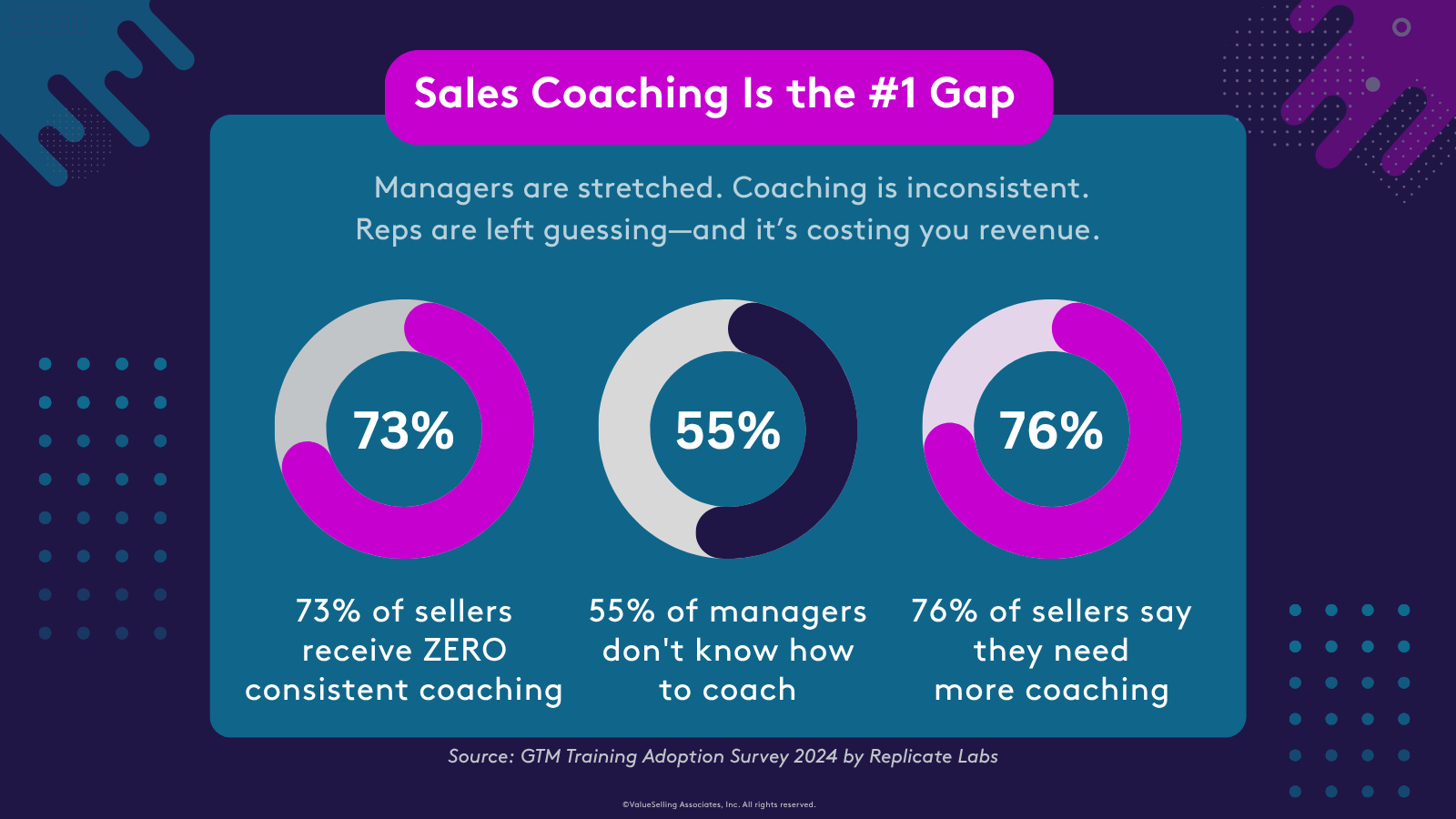
The data backs her up. A 2024 study from Replicate Labs found that 55% of sales managers admit they don’t know how to coach effectively. You can run the best workshops in the world, but if your managers can’t reinforce what was taught, the forgetting curve wins every time. The growing role of AI sales coaching tools can augment your manager’s capacity, help reinforce learning, and improve coaching consistency over time.
The Consistency vs Customization Trap
Companies that standardize too aggressively get polite head-nodding in one area of the world, followed by brazen noncompliance in another. Companies that customize too liberally end up with a dozen different sales processes wearing the same logo.
The organizations that navigate this well tend to follow a “common framework, local fluency”principle. With a proven sales methodology underpinning your global training program, you’ll have a common process for having better business conversations, building buyer confidence, and accelerating buying decisions. The core sales process, how you qualify opportunities, how you uncover and quantify buyer value, the coaching model—all of that stays consistent across every region. But the case studies, the role-play scenarios, the industry examples, the facilitation style, and critically, the delivery structure and all associated materials get tailored to the cultural nuances of the local market.
Nisbet shared a recent example where his team conducted more than 30 discovery calls before launching a global implementation in the B2B Revenue Executive Experience podcast episode, “The Playbook for Effective Global Sales Training atScale.” That might sound excessive, but those calls accomplished two things no headquarters-designed rollout could have achieved. First, they surfaced the local context needed to create customized materials and exercises. Second, and more importantly, they gave regional leaders a voice in the process before the first workshop ever happened. By the time the training launched, those leaders felt like co-creators.
Why This Works Across Cultures
One of the most frequent objections to any global sales methodology is the assumption that selling styles are too culturally specific to standardize. After all, the way you build rapport in São Paulo differs from Stockholm, and business card etiquette inTokyo bears little resemblance to a handshake in Houston.
However, the underlying psychology of buying is remarkably universal. Buyers everywhere want to feel understood, and they want to arrive at conclusions themselves rather than being told what to think. Because of these universal motivations, they respond best to sellers who treat them as partners in solving a business problem rather than targets for a quota.
If your sales methodology requires a wall of spreadsheets and AI-driven prompts inside sales calls to execute, busy sellers in any culture will abandon it. If it provides a clear, intuitive structure for having better conversations with buyers, it gets adopted.
Growing Where the Demand Is
We’re seeing this conviction play out in real time. As more multinational organizations look to align their revenue teams across APAC, the demand for structured, value-based sales training delivered in local languages (Mandarin, Japanese, and others) continues to grow.
As ValueSelling Associate in China, Kevin Sun said,“Value-based selling resonates in China because it honors the relationship-first tradition of local business culture while addressing a critical capability gap: converting relationship capital into quantifiable commercial value. Without this translation mechanism, networks remain purely social; with a structured value-communication framework, they become a genuine competitive advantage.”
The same points resonate with ValueSelling Associate in Japan, Tetsuro Yamamoto, who said, “In our current selling environment, value must be clearer, more structured, and more aligned across the organization. Throughout my career, I have seen talented teams struggle—not because of lack of effort—but because value was not clearly defined and agreed upon.”
WhereSales Leaders Should Start
If you’re a revenue leader evaluating a global training initiative, the checklist is shorter than you might expect:
- Start with a methodology that’s powerful but flexible enough to be adopted across regions.
- Invest in coaching and manager enablement.
- Embed the methodology into your existing tech.
- Give your regional leaders a genuine role in shaping the implementation.
The organizations that get this right build powerful training programs, and most crucially, they build a common language for talking about deals, coaching performance, and forecasting revenue that works from Kansas City to Kuala Lumpur.
Share this post


About the Author

Explore More


.png)
.png)